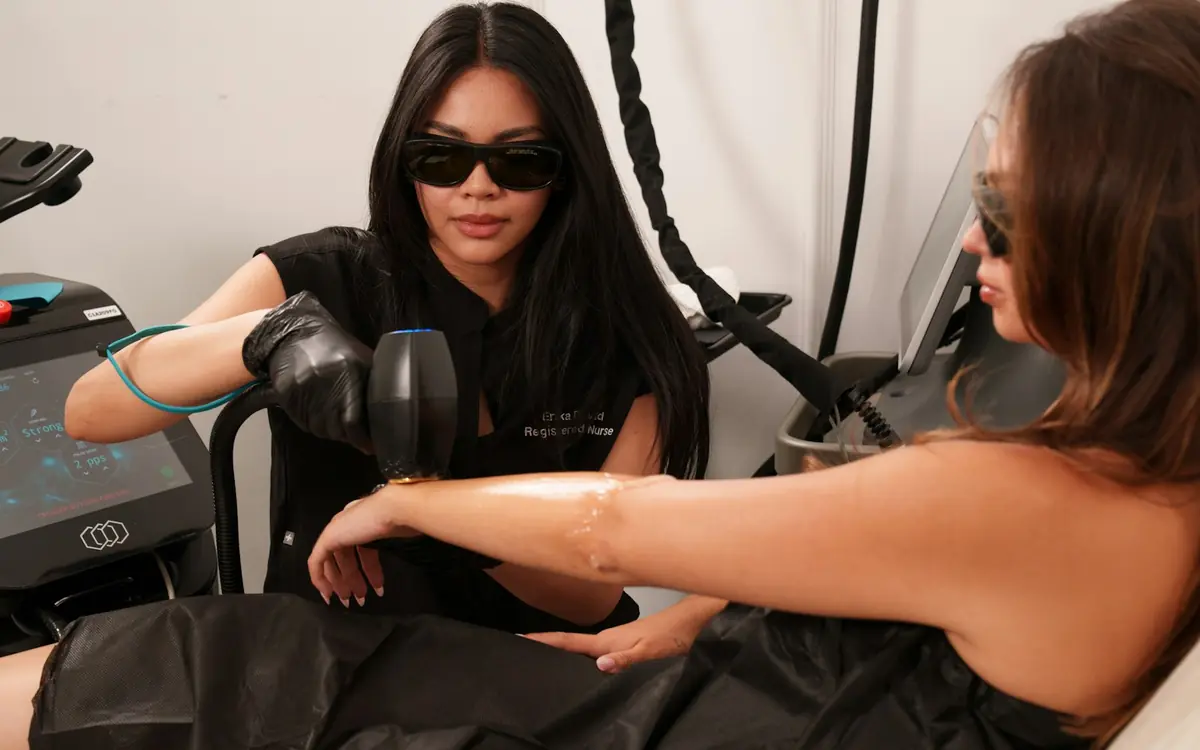
At every session with an energy device you note down: which device, when, who used it, the patient's phototype, the area, the parameters exactly as the display shows them, the number of passes, the cooling, what you observed at the end of the session and the immediate reactions. The same device, on the same patient, can run with different settings from one session to the next. If you don't write them down, nobody will be able to reconstruct them.
The parameters are the ones the machine lets you read, with their unit. Below you'll find what to note down, what distinguishes an expected reaction from a complication and what the texts say about the device log. No recommended values: which settings to use for that patient is your choice.
Why you write at every session
A standard operating protocol for energy devices starts from a practical observation: in many centres the doctor who prescribes the treatment and the person who performs it are different people, and this is why protocols that are the same for everyone are needed (Mysore et al., 2024 (opens in a new tab)). The same text requires that parameters be set according to the doctor's written instructions and rechecked before every treatment, and that for Q-switched lasers a test shot be fired on black paper to check that the device is working. If the doctor doesn't write the parameters and the operator doesn't copy them, there is nothing to check.
Reviews on complications explain why the numbers matter. A 2026 review lists among the causes of complications the unsuitable choice of device, inappropriate settings, insufficient patient assessment and the limited experience of the operator, and adds that high fluences, unsuitable pulse durations or insufficient cooling can cause epidermal and dermal injuries, including burns, scars and pigmentary changes. Among the avoidable problems it also cites relying on the manufacturer's settings (Nguyen et al., 2026 (opens in a new tab)). A StatPearls entry says the same thing from the opposite side: most complications are prevented with safety protocols, conservative energy settings and eye protection (StatPearls, Laser Complications (opens in a new tab)).
These sources explain why the parameters matter, not which ones to use. They ask the clinical record for one thing only: that, if a reaction appears, you can answer the question "with which settings?".
What to note down
| Data | Why |
|---|---|
| Device: name, model, serial number | A practice has more than one device, and the serial number is the first thing technical support asks for |
| Date, time, who decided the parameters and who performed the treatment | The prescriber and the operator may be different people |
| Fitzpatrick phototype | The 2026 review identifies it, together with UV exposure, as the most important risk factor among patient-related ones |
| Treated area | With the photo or the map, so you can find it again at the next session |
| Parameters read from the display, with the unit | Wavelength, energy or fluence, pulse duration, spot size, frequency, number of passes |
| Cooling | It is part of the causes of injury that the literature cites together with fluence and duration |
| Observed endpoint and immediate reactions | They tell you how the skin responded, and from the next session they are read together with the parameters |
| Session consent and photos | The protocol requires a signed consent before every repeated session, with the date, and photos with the same room, the same camera and the same angles |
Some devices have their own parameters, and the protocol describes them. For fractional lasers, the step between treated microzones and the repetition of pulses on the same point (stacking); for microneedling radiofrequency, the tip used (with different numbers and depths of needles), the mode (fixed, cycle, burst), the energy and the pulse rate; for cryolipolysis, the shape and size of the applicator, which the protocol requires to be marked on the treatment form so that subsequent sessions are reproducible. For focused ultrasound, a 2026 review lists among the risk factors incorrect coupling of the transducer, operator ergonomics and pulse overlap (Dicker et al., 2026 (opens in a new tab)): the transducer and the number of passes are data to write down.
A habit that helps: copy the numbers from the display and not from what you remember, with the unit next to them. "Fluence 12" without the unit can't be read two years from now.
Expected reaction or complication
The 2026 review distinguishes expected physiological responses (erythema, oedema, purpura, crusts), which it regards as expected effects rather than true complications, from immediate complications (vesicles, infections and inflammatory reactions) and from late ones (burns, pigmentary changes, ulcerations, scars, paradoxical darkening or hypertrichosis, unwanted hair loss, eye damage) (PMC12968952 (opens in a new tab)).
For the clinical record this means two different places. Expected reactions you write in the session, with the time and how they appear. A complication is recorded separately, with the date you saw it, the severity you choose and what you did, linked to the session that produced it. How to recheck a patient in the following days is in the article on follow-up after treatment; the short guide is after a complication.
The device: maintenance and checks
The same texts say what the people who write the rules for a device expect. For professional ones, the manufacturer must state in the instructions the cleaning and maintenance, the measurement of the radiant energy density and the safety measures at least once a year, and recommend an electrical safety test and maintenance at least once a year (Annex VI, point 6.3 (opens in a new tab)). Among the safety measures the manufacturer applies to professional devices, point 5.1 also cites recording emissions via the device: if your device keeps an internal log, ask your supplier how to read it. The settings that go in the clinical record are in any case those of that session.
To have a point of comparison outside Italy: the 2026 review describes the German regulation on non-ionising radiation (NiSV), which requires every treatment to be documented, including consent, parameters and adverse events, and devices to be inspected, maintained and calibrated at regular intervals. It is a German rule, cited here to show what a regulator can require, not as an Italian obligation.
The operating protocol then lists room checks that lend themselves to a checklist before treatment:
- Parameters set according to the doctor's written instructions
- Protective eyewear suitable for the device's wavelength, for patient and staff
- Handpiece lens clean
- Session consent signed and dated
- Baseline photos in the same room and with the same angles as the previous ones
Why the device has a manufacturer's file
Lasers and high-intensity pulsed light equipment, even when the manufacturer does not claim a medical purpose, fall under Annex XVI of the medical devices regulation (point 5 (opens in a new tab)). The European guidance on Annex XVI notes that "high intensity" is not defined and refers it to the capacity to produce on tissue the effect necessary for the product's purpose; it also specifies that radiofrequency can be another type of electromagnetic radiation (MDCG 2023-5 (opens in a new tab)). Whether your device falls within the list is stated by the manufacturer. The framework is in the article on Annex XVI, and for the data of injected products there is batch traceability.
How Fibonacci does it
The equipment log keeps, for every device, what it is, when it entered the practice, the date of the last maintenance and that of the next. It warns you when a deadline is approaching or has passed and it doesn't block anything: using a device with overdue maintenance is your decision and your responsibility. Two tips from the log: write the serial number, and if a device leaves the practice don't delete it, note when it left.
In recording a treatment, when the product chosen is recognised as a laser or other energy device, the Delivery parameters box appears: wavelength, fluence, spot, frequency, pulse duration with its unit, number of passes, density, cooling and observed clinical endpoint. The fields are free and without proposed values: the numbers are read from the display, because a menu of typical values would amount to suggesting a setting. The system records and does not calculate; if a value seems inconsistent it warns you, but it doesn't block saving. Dictation does not fill in these fields, which must be written by hand. For general information on the log of sessions and products see the page on traceability.